
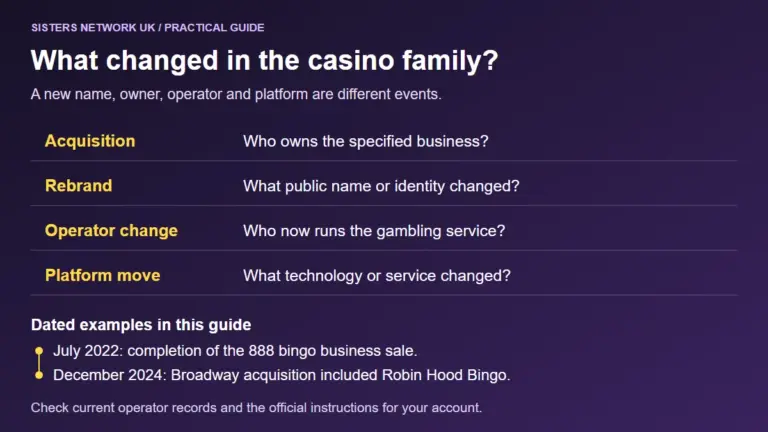
What actually changed?
A familiar brand name can make an old sister-site list look more current than it is. The page may stay online long after the company picture has changed. Begin with the exact domain and the operator named in the current legal information, then put that alongside the dated event to see what each source actually describes.
A rebrand changes the public identity. An acquisition concerns ownership. An operator change concerns the business running the service. A platform move concerns technology or service arrangements. Several can happen together, but none should be assumed from another.
Keep the useful history, but give it a date and a clear role. An old company name can still help you understand a notice or an earlier article, so there is no need to erase it. Label it as historical once it stops describing the current service, and the reader can follow the change without mistaking yesterday’s relationship for today’s.
Casino websites
Casino offers to compare separately
These are commercial alternatives to compare. Inclusion here does not establish a shared owner or operator; the relationship section above explains the connections covered by this guide.
Compare each casino's sister sites, operator and account details.

Zizobet
Promotion details800% Up to £7,800 + 1000 Free Spins + 25% Cashback

Wildies
Promotion detailsWelcome Pack 400% up to £3,200 + 150 FS

Cosmobet
Promotion details750% + Up to £7,000 + 1000 Free Spins + 25% Cashback

Rolletto
Promotion detailsSee current Rolletto offers

SlotRoyals
Promotion detailsWelcome Bonus 200% up to £1,700 + 200 FS

WinBeast
Promotion detailsWelcome Pack £5,000 + 500 Free Spins

Velobet
Promotion details700% + Up to £7,500 + 1000 Free Spins + 25% Cashback
ShelbyWin
Promotion details€6,000 + 500 Free Spins

Smash Casino
Promotion details600% Up to £10,000 + 25% Cashback

Odin Fortune
Promotion detailsWelcome Package 700% + 700 Free Spins up to 4,000 (currency not specified)
Gambiva
Promotion details800% up to €10,000 + 25% Cashback
LegionBet
Promotion details125% Bonus up to £20,000
Four events, four different questions
The table separates the change in the business from the question a customer may need answered.
| Event | What it establishes | What still needs evidence |
|---|---|---|
| Acquisition | A documented transfer or change of ownership | Completion date and the exact assets or companies involved |
| Rebrand | A change of customer-facing name or identity | Whether operator, domain or account arrangements also changed |
| Operator change | A different business named for the service | The effective date and current customer instructions |
| Platform move | A stated technology or service change | Whether ownership or customer access changed as well |
A closure or migration introduces another practical question: where an existing customer is instructed to go. Use the official account notice for that answer. A comparison article should not invent a replacement destination or promise that a balance has transferred.
The 888 bingo sale
Evoke’s 7 July 2022 completion announcement documents the sale of its bingo business. That dated event explains why a familiar 888 bingo name should not automatically be assigned to the same current company family as every 888 casino or poker product.
The present operator question still needs current evidence. The Broadway Gaming Ireland DF Limited record lists 888ladies.com with other named domains. The historic sale and the current record answer different parts of the story.
The useful conclusion is not that every brand with a number in its name moved together. It is that the specified business transaction changed the context for particular brands. Keep the exact names and domains attached to the event.
The 888 Ladies profile supplies the individual relationship answer, while the Evoke and Broadway guides explain the separate family contexts.
Robin Hood’s older Rank context
Broadway’s December 2024 acquisition announcement names Robin Hood Bingo among assets acquired from Rank. The current Broadway Ireland operator record provides another dated part of its story.
That explains why a reader may encounter a former Rank association and a current Broadway relationship for the same familiar brand. The old connection can be useful history without defining today’s sister-site shortlist.
It would be a mistake to extend one announcement to every casino ever mentioned beside Rank or Broadway. Read the named assets and current domain evidence. A transaction affecting particular brands is not a blanket transfer of every related business.
The new Robin Hood Bingo guide keeps this distinction visible. The Rank Interactive guide remains a separate current research route.
Read the notice for your account
A company announcement explains the transaction. An account notice explains the customer action, if any. Do not use one to fill gaps in the other.
Read whether the notice concerns login details, a new domain, balances, verification, offers or payment arrangements. These are separate functions. A new name does not prove that all of them changed; a shared parent does not prove that none did.
Keep the original account records with the company and service they concern. If a message claims that funds or an account have moved, verify the destination through an independently established official route before acting. A familiar logo alone is not enough.
Ask support about one precise issue at a time. For example: does the existing login remain the published route after the stated effective date, or does the current notice describe a new process? The account guide helps separate those questions.
This guide does not promise a transfer, refund, new offer or particular processing time following an acquisition. Those answers must come from the official instructions relevant to the account.
Announcement, completion and current terms
Three dates can appear in the same story. A transaction may be announced, completed later and reflected in customer-facing terms on another date. Establish what each source says happened, rather than treating the first headline as the moment every arrangement changed.
For corporate research, use the relevant company announcements and Companies House where a UK company record is relevant. For the current gambling-service operator, use the business register alongside the exact domain’s terms.
A platform announcement belongs in its own field. If the interface changes but the legal operator does not, that may be a technology event rather than an acquisition. The operator-versus-provider guide explains the distinction.
If the trail remains incomplete, preserve the dates and state the limit. “This source documents the earlier owner; the current operator record names this company” is more useful than forcing the entire history into a single timeless label.
A three-date example
Imagine a hypothetical sale announced in March, completed in June and reflected in revised customer terms in July. A March news story, June completion notice and July legal page can all be accurate while describing different stages.
The announcement establishes what the parties said they intended or agreed, subject to the wording of that announcement. The completion notice establishes the event it says has completed. The current terms identify the service arrangements described at the later date.
Do not collapse those stages into one sentence saying that every customer detail changed in March. Equally, do not ignore the completed transaction because an older legal page is still visible in an archive.
A useful timeline records the source, date and event together. It can be short: announcement, completion, current operator wording. Add a customer-action date only if an official notice supplies one.
| Hypothetical date | Source | Conclusion supported |
|---|---|---|
| March | Sale announcement | The stated transaction was announced |
| June | Completion notice | The stated transaction completed |
| July | Current service terms | The company wording now attached to that service |
The dates in this example are illustrative. The method applies to real events only with their actual sources. It is particularly useful when an older sister-site article and a current account notice seem to disagree.
What exactly was acquired?
A transaction can concern a company, a portfolio of brands, selected assets or another specified business interest. Read the object of the announcement before extending the conclusion.
If an announcement names three brands, it does not automatically establish the status of every brand previously associated with the seller. If it concerns shares in an operating company, the effect may be described at a different corporate level from a sale of brand assets.
The language also matters when distinguishing brand rights from gambling operations. A familiar consumer identity can be used through a documented arrangement without every wider business carrying that name belonging to the operator.
For a sister-site list, the practical question is which exact domains or brands the current evidence connects. A broad transaction headline is useful context, but the final current list should not depend on assumptions about unnamed assets.
This is why the Robin Hood example remains tied to the named brand and documented event. It does not become a claim about every old Rank bingo destination. The same restraint applies to the 888 bingo sale.
If a source leaves the scope unclear, preserve that limit. You can explain the announced transaction while using current domain-level evidence for the service a reader actually asked about.
A new name can preserve an old relationship
Consider a hypothetical casino that changes its public name and logo while the current terms continue to identify the same operator. The visible identity changed; the inspected company information does not, by itself, establish a new owner.
The useful historical note connects the old and new names only where an official source confirms the link. Similar artwork, a redirected page or a third-party claim alone may not explain the entire relationship.
For an existing customer, the question is whether the official notice describes any change to login, domain, balance or product access. Do not assume a fresh registration is required simply because the page looks new.
For a prospective customer, the new name does not automatically establish a new-customer offer. Existing-account and related-brand terms may remain relevant. The promotion’s own wording must settle eligibility.
For an ownership researcher, retain the old name when it helps locate a dated source, but make the current name clear. That avoids two opposite errors: treating one rebranded service as two unrelated casinos, or erasing the history so completely that older records become impossible to understand.
A good rebrand explanation therefore answers three modest questions: which names are linked, what the official source says changed and which customer details require their own current instructions.
A new interface can keep the same operator
A different lobby or account screen can be a visible sign of a platform change. It is not enough, on its own, to establish an acquisition.
A current supplier announcement may identify the technology being introduced, while the brand’s terms continue to identify the existing operating company. Those statements concern different roles and can fit together.
The change may still matter to a customer. Game search, product navigation or the way information is presented can differ. The current service should be inspected for the task the reader wants to perform rather than described using an old interface review.
Keep account instructions separate from appearance. A redesigned sign-in form does not necessarily establish a new account, and a familiar form does not guarantee unchanged rules. Follow the official notice and help route.
For a sister-site map, a platform move can change the technology field without changing the ownership field. That is why the provider and operator should be recorded separately from the start.
If the change involves both technology and ownership, describe both events with their sources. There is no need to force a complicated history into a single label when two clear sentences would explain it more accurately.
When the useful answer is historical
Some casino names need coverage because readers remember an old brand or have found it in a dated family list. That does not mean the guide should present the name as a current registration opportunity.
Casino Joy is an example of a historical relationship page in this directory. It documents the former Genesis context and material licence history while keeping present availability unestablished unless current domain-specific evidence supports it.
A historical guide can help identify the company and period relevant to an old reference. It should not imply that a current website with a familiar name has inherited every former account or obligation.
An unavailable page also has limits as evidence. A request can fail for several reasons, and one failed visit does not establish the status of every former family domain worldwide. Conversely, a page loading does not prove that a historic licence or operator arrangement remains current.
For an old account issue, use official information relevant to the original service and retain the associated records. A sister-site article cannot promise recovery or nominate a replacement casino as responsible without evidence.
The value of the historical answer is clarity about the past and the boundary around the present. It is useful even when it does not lead to a current offer.
Describe the correction that is actually needed
A useful correction report identifies the claim that became outdated. “This brand moved” is less precise than naming the former operator statement, the current domain and the official source establishing the change.
Say whether the issue concerns a parent, direct operator, public name, platform or customer instruction. These fields can change independently. A correction to one should not automatically rewrite all the others.
Include the source date and, where stated, the effective date. If the source is an announcement rather than a completion notice, make that clear. If it concerns selected assets, retain the named scope.
The same method helps a reader interpret an update on a guide. A relationship correction should explain what changed and why the new wording is more accurate, without implying that unrelated product terms were tested at the same time.
Keep private account information out of the editorial report. The evidence needed to correct a public company claim is normally public company or operator material. The casino’s own support route remains responsible for personal account questions.
This produces a more useful history than a long list of vague “updated” dates. Each material change has a subject, source and scope that the reader can understand.
Build the present shortlist
Once the current relationship is established, compare the brands as they are now. Do not carry every former sibling into the new family list. Equally, do not discard useful historical names when they explain why an older account notice uses different wording.
For a named casino, start with the directory. If the group is already known, the Entain, Gamesys and other network profiles provide the relevant company routes. The ownership lookup guide shows how to follow the source trail.
The Evoke and Entain comparison concerns two distinct group maps, not an implication that a particular transaction joined them. Use comparisons for the question they actually answer.
Report a dated relationship error through the corrections page. Include the old wording, the exact domain and the source that establishes the change. That is more useful than a general statement that a network list looks out of date.
Independent casino packages
Odin Fortune and Cosmobet are separate offer comparisons. Their placement here does not identify them as replacements for any acquired, rebranded or historical casino.
| Casino | Welcome package | Offer |
|---|---|---|
| Odin Fortune | Welcome Package 700% + 700 Free Spins up to 4,000 (currency not specified) | Odin Fortune |
| Cosmobet | 750% + Up to £7,000 + 1000 Free Spins + 25% Cashback | Cosmobet |
Odin Fortune’s 700% package and 700 spins differ from Cosmobet’s 750% headline, 1,000 spins and cashback. Their current qualifying stages and reward conditions need a fresh reading. Nothing in those figures establishes what happened to an old account after a sale or rebrand, and neither offer should be treated as a successor-account instruction.